Showing posts with label wagons. Show all posts

Sunday, 9 August 2020

July and August 2020 FCAG meetings

Two months for the price of one in this update!

Our July video meeting had the theme of wagons: Alisdair Campbell gave us a rundown on his collection, from BR prototypes to his Highland Railway fleet, from plastic kits, commercial etches, and his own etch designs, and some pure scratchbuilds. Some discussion of couplings ensued. I was not able to take any screenshots, but if Alisdair sends me his pictures I will add them here.

I had to leave the meeting at that point, but I am told there was some further discussion regarding the proposed group layout. Forfar shed is emerging as a theme. The prototype shed is still standing, in use as the headquarters of a firm of steel-framed agricultural building suppliers.

The shed building is a typical Caley design of the late 1890s but, at four roads by seven bays plus a separate fitters' shop, it is bigger than we want for our layout, which is intended as a display unit for use at exhibitions (remember them?) to convince the punters of the merits of 2FS over "N". As such, it needs to be legless (to sit on top of the exhibition table usually supplied for the 2mmSA Further North Road Show), lightweight, compact enough to go in the back of a car while still allowing four weedy FCAG members in the front (we think 3 feet long, 18 inches deep, 8 inches high when packed).
 
However, Arbroath shed, completed the year before Forfar, is very similar and had three roads by six bays. Thanks to the generosity of a friend we have its dimensions from an official drawing, so we can hopefully produce something visually convincing. In any case, it is only an inspiration for our scene, and we only aim to model one end of it. The whole thing is meant as a learning exercise, a short-life project to be disposed without ceremony once it has outlived its usefulness. The plan will be something like this Templot rendition:
The August meeting was again a Zoom affair, and consisted of a show-and-tell session. First up was a new recruit, Richard, who told us about his buildings based on Fenwick Pit in north-east England. They are made the old-fashioned way by drawing the shape onto brick-pattern-embossed styrene sheet and building up layers. The window glazing bars and much of the more delicate detail are from Evergreen microstrip. A full write-up is on RMWeb, but we were able to see the results all brought together, in front of a prototype picture on his computer screen:
Some discussion ensued on the best source of 2mm scale hopper wagon kits, with Fence Houses Model Foundry the most likely contender.

Next to go was Jim, who showed us his progress with the remarkable model he has made of the awnings for the Grampian group's Dunallander station. Again the full story is on RMWeb but it was good to hear the detailed tale directly. 
Jim has also been working on further buildings for his own Kirkallanmuir layout. He showed us one or two pictures with an explanation of how he'd created the roof textures. This is a rear view of a small stable, taken part-way through construction and before weathering. Not the most elegant photo but it was what I happened to grab during the description. I hope Jim will post full details on his RMWeb layout thread in due course.
 Andy talked us through his progress with a Fence Houses Jinty chassis, seen here during its live demonstration in motion.
Simon's subject was layout legs. Walking the rain-swept streets of the south side of Glasgow, he was struck by the number of home-assembly bed frames which turn up waiting for collection by the authorities, presumably as kids grow up and need a bigger bed or leave home. Many of these beds were of the type with wooden slats to support a mattress. It occurred to Simon that these slats were likely to be well seasoned after being indoors in a warm place for several years, unlike the wood typically available fresh from a builder's merchant or DIY warehouse. A few such slats therefore accompanied him home and were allowed to recover from the rain in his garage for a month or two.

Although the slats were preshaped to a gentle curve, he realised they could be used in pairs sliding past each other to create adjustable legs by using a wood router to cut accurate slots, and pairs of M8 bolts top and bottom to lock them at the desired height. The curved shape means there is plenty tension to ensure the legs don't slip once the bolts are tightened.
Once in place under the layout, a triangular plywood flap is opened out for lateral stability. The flap is hinged so the legs can pack down flat.
The design uses T-nuts attached to the woodwork as far as possible so that there are no wing nuts to lose. Everything is held together with M8 bolts.
Tony was next. Everyone's jaws dropped when he revealed how he'd spent a wet staycation in a caravan in glorious Scotland ... batch-building 2mmSA Black 5 kit tenders.

Not one tender. Or two or three or four or five ....

NINE tender bodies! All subtly different. Apparently the worst part is the fire-iron tunnel. Next he will tackle the functional powered chassis which runs behind the cosmetic frames.

As if this was not enough, he has also been working on Farish Jinty and 4F conversion chassis. No photos of these though.

Alisdair has been working to complete the model sewage works he promised for Tony's Hest Bank layout.
The Silhouette cutter has been used to good effect to create the roof slates on the store. The capping strips are from Plasticard.
The primary settlement tanks are of conic section. Alisdair cut them using the Silhouette from a mathematically-calculated projection which, to his slight surprise and greater satisfaction, came out right first time.
 
The concrete-paved roadway are achieved by painting concrete colour onto black card, then scoring through the surface to create the impression of large panels.
Railings are from copper bell wire made up using an aluminium jig. His ladder-soldering technique was covered in a previous blog entry.
 
We were also shown stock which has benefitted from the recently-introduced nine-spoke, 7mm wheels in the 2mmSA range. The difference is most noticeable when the vehicles in motion.
The rest of the session was spent on a quick discussion of the planned group layout. Nigel had circulated a sketch of a possible design for the basic support structure - a plywood-faced foamboard, or hollow-cell board "suitcase" with welded 1/16" aluminium framing. It turned out not everyone had received the mail in time however, and Nigel himself was busy out cycling in the sunshine (second sunny day in Scotland this year!), so we deferred full consideration for another time. The folding-hoop supports for lighting, a fascia, and a cloth sky sheet are a nice touch. The idea is that it will fit transversely into the boot of a small car and offer full protection to the model. The base will be solid with wiring feeds to the track brought out to the rear for linking. Point control may well be mechanical for simplicity, since everything is on a single board, but if necessary Arduino-driven servos may be used. Design of the turntable mechanism, whether mechanical or power-driven, is still under consideration.
It remains to be seen whether a physical meeting will be attempted in September, but the balance of opinion was that it is still too early. Time will tell.


Saturday, 20 October 2018

October 2018 meeting

Once more in sunny Edinburgh for this month's meeting. Alistair, Alisdair, new face Alastair, Stephen, Andy, Nigel, and Simon met at Graham's house.

Alisdair gave a short talk on "wagons from plastic kits", starting with a look at the 2mmSA 1887 RCH kit and how it can be bashed into a number of interesting variants: he showed us a North British 3-plank and a Highland 5-plank wagon:


He also reminded us of the Buchanan Kits strapping etch designed for this wagon, which can be used to create the characteristic Scottish "cupboard door" mineral wagons:


The mouldings are rather thick in this kit and can be considerably improved by thinning them down with a large file, then scribing planking on the back:

More modern prototypes covered included BR 16-ton minerals: comparing the Association plastic kit with the Stephen Harris etched version, and the relative amount of time required for each:


One issue with plastic kits is the tendency for their sides to bow in (while the prototype tended to bow out after extended use). Alisdair counteracts this with a strip of Plasticard slightly wider than the wagon, inserted and left for a few weeks so the sides regain the correct shape. The Association Ministry of Works coal wagon kit was also discussed, with a warning that neither of the two etched chassis suggested for this moulding fit it well (see the instructions for 2-501c), and that careful work is required to make a convincing wagon.


While this was going on, Nigel, ever industrious, worked away at wagon wheel assembly:


Stephen had a Revolution Trains' Cargowaggon in 1:148 scale for us to admire. The printing is very fine:


After lunching on bacon rolls, we moved on to consider the business of the day. The objective was to do further work on Sauchenford's fiddle yards, cutting and fitting brass plates where required. This necessitated a fair bit of "planning": everyone had an opinion.


Our external assessor for the day, Mick Simpson from the North East Area Group, arrived in time to polish off the last bacon rolls and some cake. He showed us his party trick of making chocolate biscuits disappear:


He also dispensed much valuable advice regarding Electra couplings. He was able to watch Alisdair explaining finescale techniques to Alastair, who also works in 5-inch gauge live steam, and who'd come along for the first time to get some advice on the layout he's planning based on the original, pre-Forth-Bridge South Queensferry station. I think he'd expected 2FS to be more delicate:


Next month's meeting is likely to be in Lockerbie.

Sunday, 15 January 2017

January 2017 meeting

The first meeting of the New Year saw us back on the west coast. Alisdair hosted and Alistair, Andy, Anthony, Stephen, Simon, and Graham drank his tea and coffee and ate his bacon rolls and cakes.

Some modelling was done as well however, around the kitchen table in best Area Group tradition..


For most the focus was on the 2016 Challenge: produce a diorama on a 20cm x 16cm base with, at minimum, some trackwork to 2mmSA standards - an opportunity to try out new techniques, or an excuse to model something different from a main project.

Jim was absent this time, but nonetheless we felt his presence in the room because of his latest status report on his goods yard scene on RMWeb, which he'd followed up with a few stern e-mails telling the rest of us to get our fingers out. So who obeyed?

Alisdair has built a cameo inspired by the 3' gauge Upper Works Railway in Lochaber, which linked the British Aluminium Company works near Fort William to its extensive hydro-electric schemes at Loch Trieg and Loch Laggan, and serviced the tunnels, valve shafts and pipelines along the way. It's not complete, but already looks impressive.


As a civil engineer he identifies with the subject, which he discovered hill-walking in the 1970s; presuming the railway to be defunct, he crossed a burn using one of its spindly, handrail-less bridges, and was mildly startled when a train rattled past him on its way downhill a few minutes later.


He has modelled a scene with twin pipelines crossing a small burn, and the 3' line on a timber bridge behind.


A cardboard box was adapted to become a proscenium arch and lighting unit - the latter using LED strips and a remote control (whit!) to vary their intensity.


As usual Alisdair's structures look the part: the stonework of the culvert where the pipelines are exposed is subtly convincing. The poor colour balance in my photos doesn't do justice to the model.


Simon has killed two birds with one stone: his father Russ modelled an N gauge station building over 40 years ago and, for his 80th birthday, Simon decided to place it in a suitable context for display. So his diorama is an island platform with a retaining wall as a backscene.


Even with the building loosely placed on the platform it looks at home.


The scene is named "Dalmally" ... which will have a few people scratching their heads, since Dalmally is on the Callander and Oban and has a two-storey stone station building, whereas this specimen is clearly a typical West Highland Railway design. The explanation is that the building originally graced an N gauge layout inspired by the idea of a West Highland branch to Tarbert (Loch Fyne), with an intermediate station at Dalmally. So there ... Rule 1 applies.


And for those of you reaching for a tape measure, yes, it is not strictly 16cm x 20cm. There are exceptions for 80th birthdays, and anyway the building is longer than 20cm on its own!

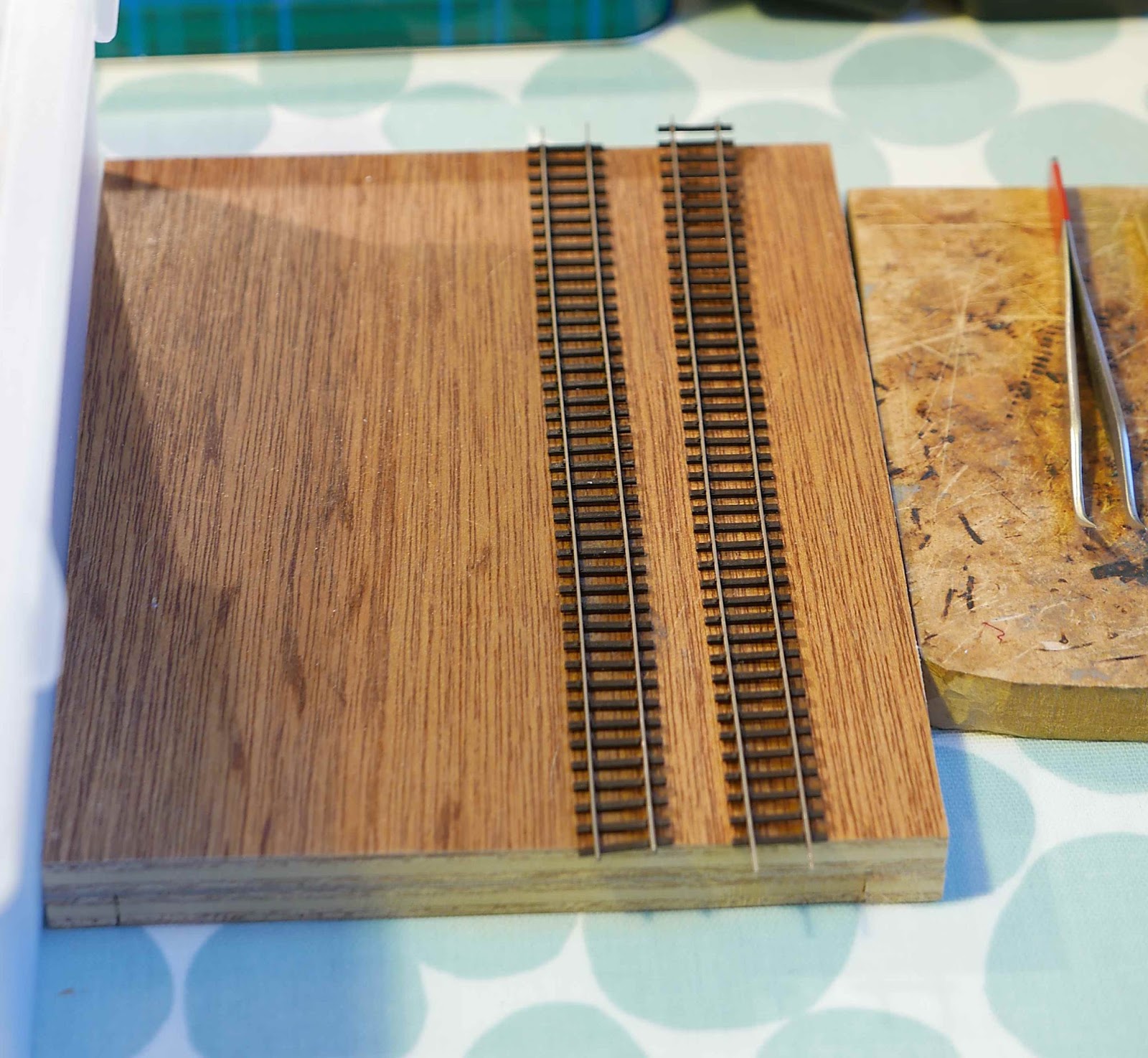
Andy has spent most of his time building a bathroom and kitchen in 1:1 scale recently, but had brought wood and Easitrac. With domestic tasks out of sight and mind, he finally started his diorama:


Alistair progressed his model of a railway scene with low-relief tenement backscene:


Anthony, visiting his old FCAG haunts after (we assume) getting a special day pass from the NEAG, was working on a coach bogie.


He also had a nice box of his own stock with him. At the top, two open wagons from Jim Watt's Buchanan Kits etches; below, his own scratchbuilt Highland Railway brake van and open wagons, plus a Highland 6-wheel composite and a double-deck sheep van, both from his own etches.


The coach is worth a closer look: it is built up from four (or was it five?) layers of etch. Anthony admits to chosing a prototype with absolutely no tumblehome, which simplified matters a little. The centre axle simply slides in inside bearings; there are no Cleminson trucks. All very nice.


Stephen was working on a buffer-stop for his diorama. Fired with enthusiasm from the meeting, he continued to work on the trackbed once back home, and sent this photo (from which we can deduce his scene will have two track levels). Whether voodoo or acupuncture is involved is not known, but it seems to work for Stephen.


My progress was a little less spectacular, but I did make a start on soldering up some of the windows for the GNSR loco shed at Macduff which will be my challenge entry. Jim Watt very kindly drew up and etched these for me: they fold up in a "Z" ...


with the centre part spacing the two sets of astragals apart, so that a piece of glazing material can be slipped in between the layers. 


These are windows for the store, 1cm high: the arched windows for the shed itself are larger and work the same way. I'm looking forward to starting those.

So John Knox Jim's fiery sermons to the FCAG congregation seem to have had some effect, and even the greatest sinners (who are mysteriously all from the East Coast) have started on the long road to redemption. Only four weeks now to the deadline!

Friday, 19 August 2016

August 2016 meeting

Alisdair's report with Andy's pictures: The August Forth and Clyde meeting took place on the 13th, with five of the Group attending a secret location in Glasgow, the Doyen of the West. This included Martin, the new boy, who after the usual humiliating initiation rites (used up all our permanent markers, treacle and feathers, so it did, yet he never apologised), joined the workers at the kitchen table while Jim used some unusual words when trying to get his patent ground signal operating mechanisms to work on the layout. Jim has since made further progress (see his RMWeb description). Here's how they look in situ on Sauchenford: first Jim putting the "big signal" (a Stevens lower-quadrant with co-acting arms, representing Sauchenford's Down home) into its socket on the layout:


The driver's-eye view through the bridge.


 And the view from the other side:


We look forward to seeing the end result at the Aln Valley Railway Model Railway Exhibition on 3rd and 4th September which the Group will be attending with the 2mm Scale Association Roadshow.

As well as the tea, coffee and strange brew imbibing, the Kitchen Table Workers were busy with Martin creating some pointwork using his own ingenious system for constructing flatbottom rail turnouts, Alistair creating buildings for a model of a model in planning. Andy was beavering away at the end of the Kitchen Table detailing his LNER brake van when not assisting in the signal installation.


Some point servos were being constructed by Alisdair ... 


... using Martin’s design of laser cut servo holders – an excellent and useful invention.


Jim had brought along some completed Caledonian Railway wagons created from his own etches which looked extremely good.


The tea bag tarpaulin looked particularly effective:


as did the horse-drawn lorry.


See his catalogue here! (usual fiver Jim, thanks ...)

A good meeting with progress for everybody. Next event will be an invasion of the NEAG meeting on 27th August, with the next FnC regular meeting being on the 17th September, again in the Glasgow area.

Postscript: Graham was absent in the frozen north on a family holiday, but he still found time to visit a few ex-Highland Railway station he hadn't seen for many years. Dornoch station building still survives in remarkably good order, some 60 years after closure: it's now a chiropractic clinic.


The small museum in Dunrobin station building was open:


Thurso and Wick station buildings looked very spick and span, although very much now "basic railway", but the track is run down in places. The weedkilling train has obviously not been to Georgemas Junction for a while - this is the Down (well, nowadays the only) platform, looking to Inverness with the Thurso branch curving off to the right). The line to Wick was even more of a jungle.

And at Wick itself, the run-round loop has a sleeper which is more air than timber. (To be fair, all regular services are units, so no need to use the loop).


Try modelling that in 2mm scale!