Showing posts with label signals. Show all posts

Sunday, 11 June 2017

June 2017 meeting

Six of us gathered in Edinburgh for June's get-together. The early morning rain was all to the good: it banished thoughts of healthier outdoor pursuits and gave an excuse for a day's modelling. There was a fair bit of blethering but we also got some work done on Sauchenford, the group's layout.

Jim had brought his latest signal from his Kirkallanmuir project for inspection. He's already described this on RMWeb, but another photo doesn't hurt. Note the ground signal positioned in front of the post of the  bracket signal.


Just to show he's no one-trick pony, Jim had also brought along some of his 4mm work. Yes, 4mm ... it seems that in his mis-spent youth he planned an enormous Hornby Dublo 3-rail empire in his parents' loft. Some of the rolling stock survived, and he brought it along to show us. Jim claimed these were built entirely from cardboard. Under some pressure from a hostile audience, he admitted the wheels, axles and couplings are not in fact card, but everything else including the underframes is. Presumably they burst into flames when the brakes are applied. They don't look too shabby for a teenager's models from half a century ago.


Jim also demonstrated the fine art of hooking up the operating mechanism for the ground signals on Sauchenford. It seems you need all ten fingers and laser vision to do this.


Nigel was working on changing the stay-alive capacitors from ceramic to tantalum types on his 02 class shunter (body from a Worsley Works NS etch, scratchbuilt chassis), in order to benefit from their superior performance at the DCC operating voltage. He explains the background in his blog. In this shot, the old ceramic capacitors are still attached to the loco. In the background is a block of old tantalums used to check the space in the cab.


The next stage was to remove redundant components for cab lighting. Here, the ceramics are still in place, with their charge/discharge components visible linking them to the decoder. There was further work to do but at that stage I went off to make coffee, and by the time I got back the job was complete.The new capacitors fitted neatly in the loco cab below window level, no mean feat in such a small prototype.


Stephen had brought with him the White Rose Modelworks 30cm x 90cm lasercut baseboard kit he'd purchased at the recent Bournmoor Expo. It made up into a very robust, lightweight, perfectly square unit. Stephen already has a cunning plan for it, which he proceeded to talk us through. Rather than reveal all at this stage, I'll just show the drawing.


Alistair was meanwhile drawing out a plan for a new layout (hang on ... what happened to his previous plan(s)?). Alisdair and Nigel continued platelaying on Sauchenford while the rest of us leaned on our shovels and watched. Nigel's 02 came in handy for finding dodgy bits of track, which Sauchenford seems to sprout whenever it's in storage for a month or two. This proved the value of the stay-alive capacitors: the 02 was rock solid over the track imperfections and dirty spots which cause poor running in other locos.


The rest of the time was filled by the ritual consumption of bacon rolls (barring Nigel, who has not quite adapted to the Scottish diet yet: we stretched a point and allowed him a chicken salad just this once,  since he'd impressed us with his tantalum capacitors, but we'll be keeping him under observation) and lemon drizzle cake. The sun started to shine by mid-day, but all thoughts of healthy exercise were forgotten. Quite right too.

The FCAG team will be manning the 2mmSA Further North roadshow at the Perth MRC exhibition later this month - if you're going, please be sure to stop and say hello.

[Edited 13 June to correct details of what was going on in the photos of Nigel's 02.]

Sunday, 12 February 2017

February 2017 meeting

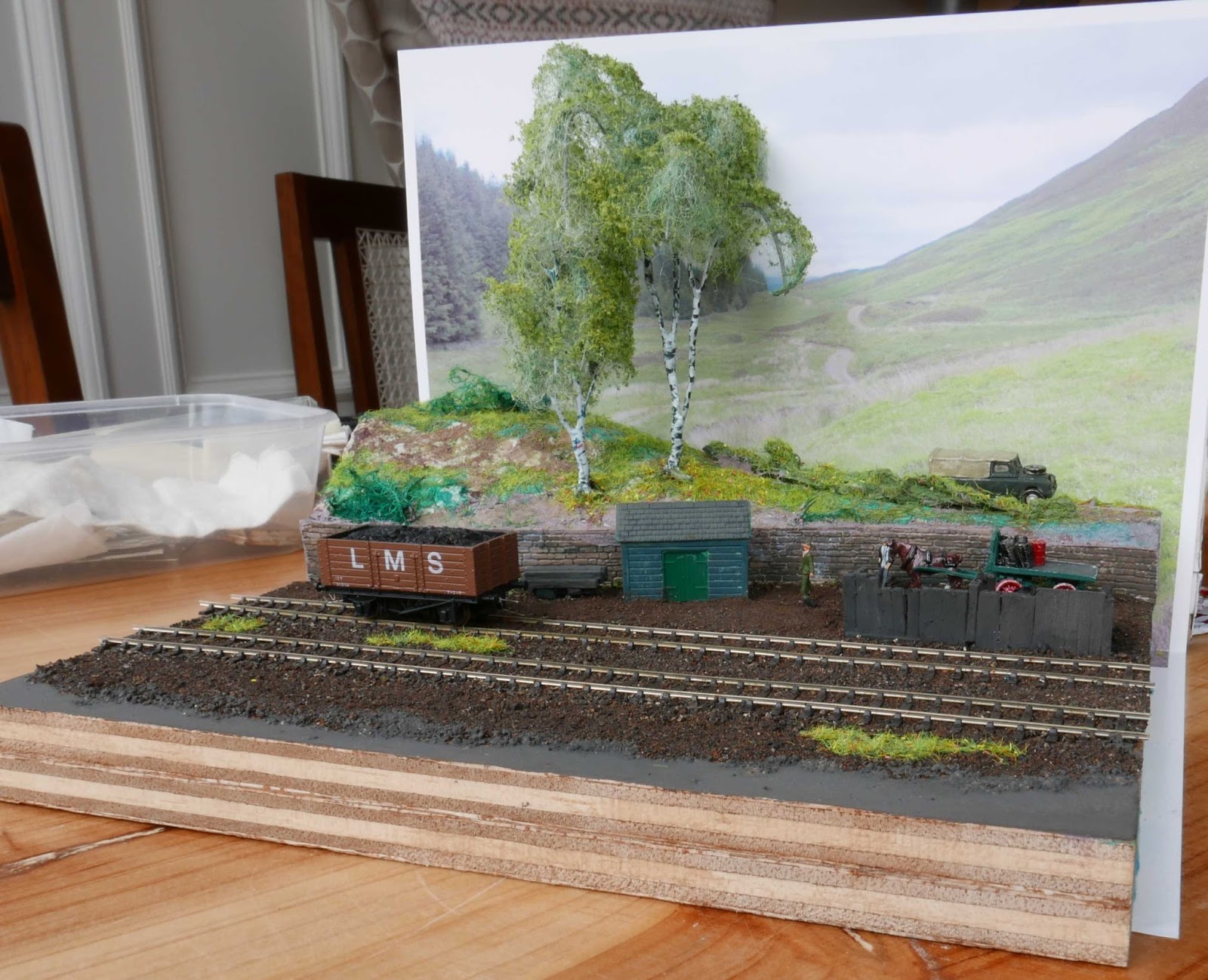
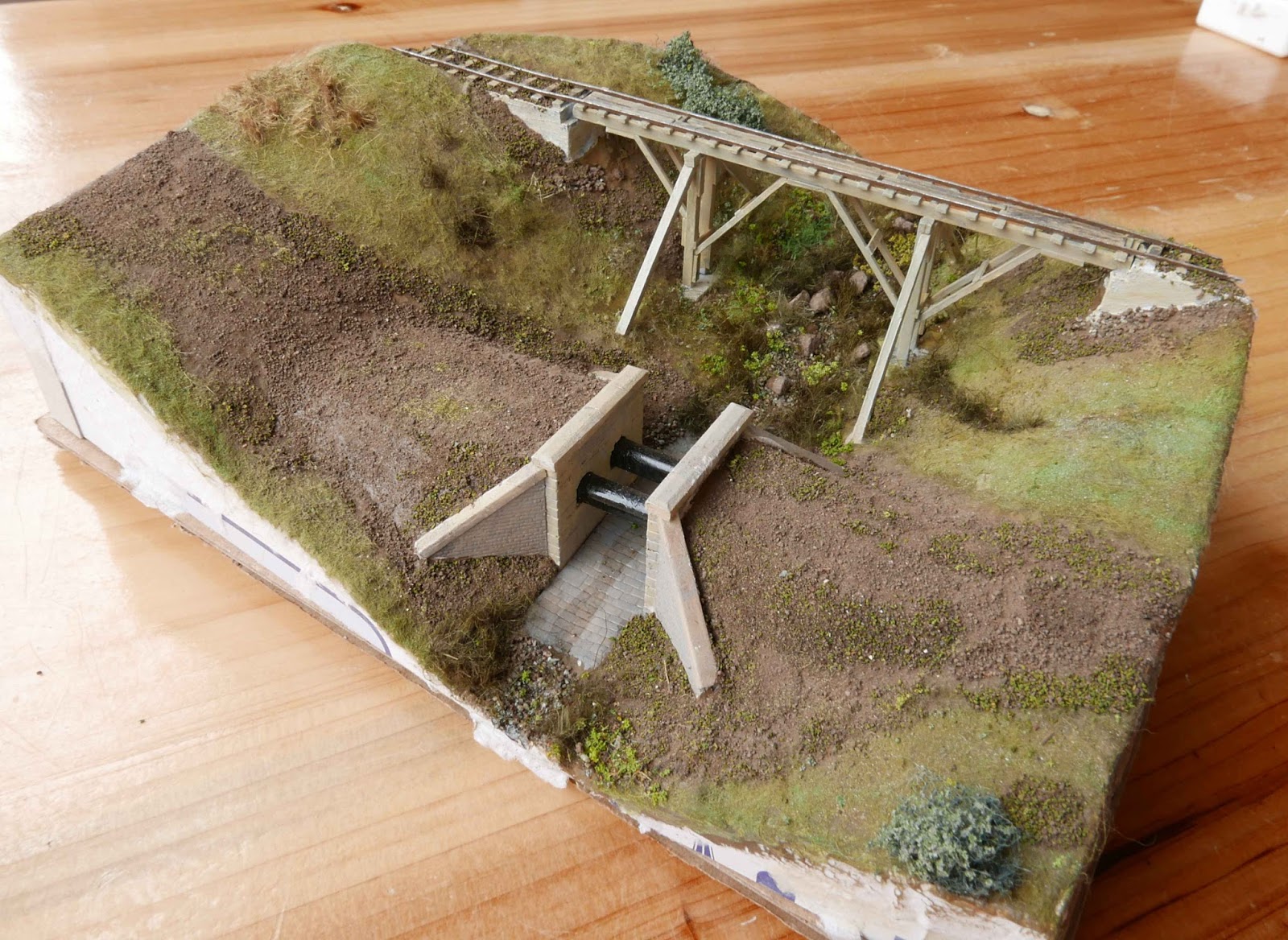
Back in Edinburgh for this month's meeting, with the wind and sleet to remind us it's February. Time for the results of the Forth and Clyde 2016 Challenge to be revealed. The idea was to model a diorama in 20cm x 16cm, with the only stipulation that it must include some track to 2mm standards. Andy, Jim and Alisdair had completed models to show.

Andy chose to model a coal merchant's siding in a rural setting; he literally put it together in an evening. Cleared of silver birch trees and structures, the board will cunningly be re-used as a fiddle yard traverser in his next project.


The red-painted drum is a paraffin tank, for retail sales as the coal merchant does his rounds.


Jim's creation has already appeared in his RMWeb postings, but here are a few more shots. The pictures say it all really.


Alisdair's diorama featured in last month's blog, but a month later there is slightly more vegetation showing:

The lid with its LED lights lifts off, revealing the frame and backscene which can be re-used for other dioramas.

It's worth clicking on the image to see the detail in the bed of the burn.


As for the rest of us, Stephen was mid-way through his model at last report, but was kidnapped by his fanily this weekend so we didn't get to see it. Simon's model featured in last month's blog entry. Graham and Alistair are in sackcloth and ashes for not finishing anythng worth picturing, in spite of four months to do the job. I'll spare you our pathetic excuses.

Jim had also brought along for inspection the locking-box for the lever frame of his layout "Kirkallanmuir", which he also described briefly on RMWeb.  This is made up from his own etches: the tappets have notches etched in place, and each bridle irons with its locks is made from a single etched unit with multiple layers which folds into place like a particularly fiendish piece of origami. The only time a lock needs to be separately positioned and soldered into place is when one is required on both sides of a tappet. This makes construction much faster and more reliable. Hopefully Jim will write it up in detail for the 2mmSA magazine.


After we'd ooh'ed and ah'ed over these various offerings, and had some lunch, finally some modelling got done.


Alisdair had got hold of a Severn Models "Tools and Wheelbarrows" etch and proceeded to entertain us for the rest of the afternoon as sundry bits of wheelbarrow flew off into the wide blue yonder.


There was some unparliamentary language. But by the end of the session, a wheelbarrow had been conjured up from the flat etch. It has to be said that a 2mm scale barrow is not large.


 Although a complete non-sequitur to the foregoing, here is an image of Alisdair's skrawker for carving surface detail into styrene sheet. Although often described, it is not always obvious exactly what form a skrawker should have. Alisdair makes his from a used Swann-Morton scalpel blade ground to shape using an abrasive wheel in a mini-drill.


Jim spent a couple of hours working on Sauchenford to re-install the ground signal Alisdair stood on at the December meeting, and to bed in some point levers which he'd etched. These too are small.


So small, indeed, that one of the three levers he installed mysteriously disappeared when our backs were turned and could not be found despite considerable searching. Alisdair didn't stand on it, or so he says. Perhaps it is still stuck in the scenery somewhere. Fortunately Jim had made a spare, so all was not lost.

And with that important detail concluded, it was time to return to reality and head off into the rain. If you are visiting  Model Rail Scotland later this month (and if not, why not?), come and have a look at our dioramas on the 2mmSA stand: C15 on the hall plan, next the Scalefour stand and opposite the Gauge 'O' Guild. See you there!


Sunday, 9 October 2016

October 2016 meeting

A number of the regular Forth & Clyde crew were unavailable for our October get-together, leaving Alisdair, Jim, Gordon and Graham a bit more space to work than usual.

Jim had brought along his recently-completed lever frames for signal operation, which he proceeded to install with Gordon assisting.


The link to the operating mechanism is by wire-in-tube. Jim's practice is to secure the PTFE tubes using ordinary office staples, bent to accommodate the tube so that it is held firmly without pinching, then carefully driven into the underside of the ply baseboard by gripping firmly with pliers and pressing home. As long as the staple goes in cleanly and the force is perpendicular to the ply, it does not buckle, otherwise it's best to start again with a new staple.


Fortified by bacon rolls, slabs of cake and mugs of tea, the job was finally completed with all signals operating smoothly from the lever frame, yet easily removed from the layout to avoid damage in transit.


Here they are in motion.


The enlargements are cruel: the signals are only 5mm high. (On Stevens ground signals, the flap drops forward to show a "proceed" aspect).


Alisdair was showing off the servo point motor wiring he's been busy installing on his shunting plank. Or maybe it's a telephone exchange. Anyway there is plenty of wire involved.


Apart from helping to eat the cake, I was able to do a bit more on my Harris Catfish kit, and we all discussed our ideas for the Forth and Clyde 2016 Challenge diorama. Roy from the Grampian group dropped in late on to pick up the 2mm SA Scottish Roadshow ready for the Aberdeen MRC show at the end of this month. And that was it: another meeting over and Sauchenford is a wee bit more complete.

Friday, 19 August 2016

August 2016 meeting

Alisdair's report with Andy's pictures: The August Forth and Clyde meeting took place on the 13th, with five of the Group attending a secret location in Glasgow, the Doyen of the West. This included Martin, the new boy, who after the usual humiliating initiation rites (used up all our permanent markers, treacle and feathers, so it did, yet he never apologised), joined the workers at the kitchen table while Jim used some unusual words when trying to get his patent ground signal operating mechanisms to work on the layout. Jim has since made further progress (see his RMWeb description). Here's how they look in situ on Sauchenford: first Jim putting the "big signal" (a Stevens lower-quadrant with co-acting arms, representing Sauchenford's Down home) into its socket on the layout:


The driver's-eye view through the bridge.


 And the view from the other side:


We look forward to seeing the end result at the Aln Valley Railway Model Railway Exhibition on 3rd and 4th September which the Group will be attending with the 2mm Scale Association Roadshow.

As well as the tea, coffee and strange brew imbibing, the Kitchen Table Workers were busy with Martin creating some pointwork using his own ingenious system for constructing flatbottom rail turnouts, Alistair creating buildings for a model of a model in planning. Andy was beavering away at the end of the Kitchen Table detailing his LNER brake van when not assisting in the signal installation.


Some point servos were being constructed by Alisdair ... 


... using Martin’s design of laser cut servo holders – an excellent and useful invention.


Jim had brought along some completed Caledonian Railway wagons created from his own etches which looked extremely good.


The tea bag tarpaulin looked particularly effective:


as did the horse-drawn lorry.


See his catalogue here! (usual fiver Jim, thanks ...)

A good meeting with progress for everybody. Next event will be an invasion of the NEAG meeting on 27th August, with the next FnC regular meeting being on the 17th September, again in the Glasgow area.

Postscript: Graham was absent in the frozen north on a family holiday, but he still found time to visit a few ex-Highland Railway station he hadn't seen for many years. Dornoch station building still survives in remarkably good order, some 60 years after closure: it's now a chiropractic clinic.


The small museum in Dunrobin station building was open:


Thurso and Wick station buildings looked very spick and span, although very much now "basic railway", but the track is run down in places. The weedkilling train has obviously not been to Georgemas Junction for a while - this is the Down (well, nowadays the only) platform, looking to Inverness with the Thurso branch curving off to the right). The line to Wick was even more of a jungle.

And at Wick itself, the run-round loop has a sleeper which is more air than timber. (To be fair, all regular services are units, so no need to use the loop).


Try modelling that in 2mm scale!