Showing posts with label glenfinnan. Show all posts

Sunday, 14 March 2021

March 2021 FCAG meeting

Our March meeting attracted 13 participants - Alisdair, Alasdair, Simon, Jim, Stephen, Mick, Nigel, Richard, Chris M, Chris G, Martin, Andy and Graham all zoomed in for a few hours of "show and tell".

Simon went first. He's constructing a turntable fiddle yard for "Glenfinnan", using a router on a trammel to get the radius right.

He's also working on an ex-LNE Coronation stock "beavertail" observation saloon, as modified by BR in the 1950s for use on the West Highland. He started with the basic shell from Simon Dawson's Rue d'Etropal range, available from Shapeways. This shot shows that the print is quite rough, but Simon found it cleaned up very easily, polishing it with sandpaper stuck to bits of wooden clothes pegs (apparently his neighbours are putting motion detectors on their drying greens).

It will need Gresley 8'6" bogies: these were ordered from the shop, received and built all in a week. This shot is of the prototype of course, not the model!

He's also still working on a tandem for the FCAG shed scene layout.

Mick has been implementing advanced DCC settings (with Nigel's help) using jmri decoder pro in order to get his Class 37's lights to behave prototypically - he's added the ability to switch off the red markers at the trailing end when hauling a train, and to light red markers at both ends when stationary on a running line. He showed us this using a mirror so we could see both end of the loco at the same time.

Chris G. has been moving ahead with pointwork for Bosaleck. There are guitar-string droppers (arrowed red) from the point blades which engage in the tubes on the operating units.

He'll shortly start work on an M7 loco conversion.

Nigel has been discussing the group's involvement in sleeper production. The current production line, established by Bill Blackburn, uses a heavyweight guillotine to reduce 2'x3' SRBP PCB sheets into 300mm x 18mm, 19mm or 20mm strips.

Next, the strips are gapped using a circular saw with a table and fence to remove the copper layer but not the SRBP substrate.

Finally a third machine (not illustrated) is used to chop individual sleepers.

These are somewhat inconvenient to store and transport for the proposed group sleeper-production sessions (sleep-overs?). Nigel has drawn up a design for a simpler gapping attachment to fit the vertical slide on a lathe: a jockey wheel keeps the sleeper blank firmly on the table and the saw blade, mounted on an arbor in the lathe, is kept out of harm's way under the table.

Further developments are expected.

Chris M. has been detailing his LMS 4F, inspired in part by Nick Mitchell's excellent tutorial. Boiler backhead fittings under construction, cruelly magnified:


 Reversing crank and coal-dampening c0ck: 

Smokebox detail:

Chimney, dome, water pickup dome and tank filler turned on the lathe:

Jim is continuing to add buildings to Kirkallanmuir along the road leading downhill from the overbridge next the station.

A "kit of parts" was cut out from styrene sheet. The baseplate has holes to locate on dowels on the baseboard: the little blocks of scrap styrene are to strengthen the joint with the wall. Jim runs a fillet of Easitrac glue along the joint as well.

In position:
Detailing:
The next building down the hill is to be based on another local nineteenth-century prototype:

The styrene shell:  

The shell in place:

Richard has been designing etches for pithead gear and for wagons. PPD must be glad he discovered 2mm modelling, he's keeping them busy!

I think I have posted shots of his build of Fencehouses Model Foundry P4 hopper kits before, but he has improved the end stanchions, which are built up from multiple layers of etch, flooded with solder.

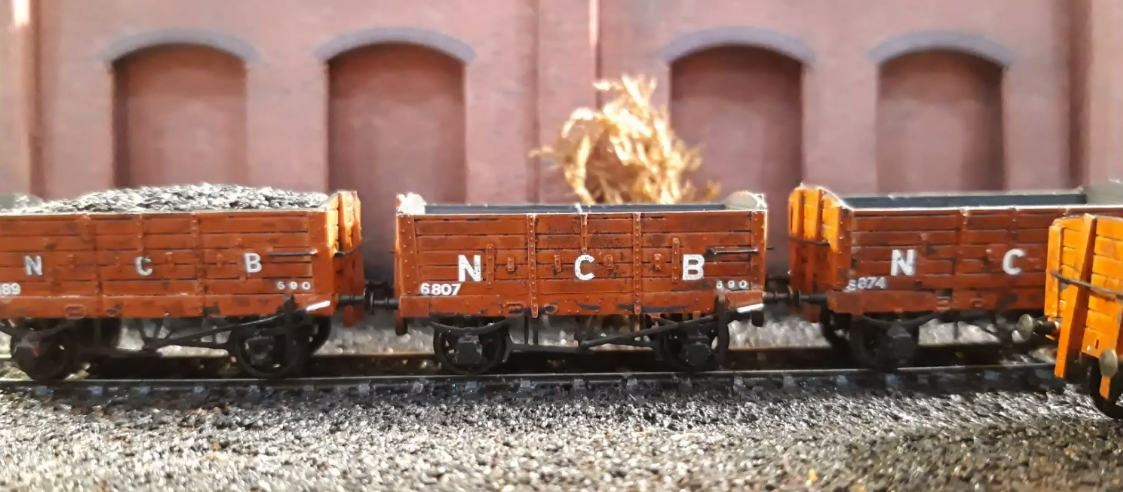
They recently made a trip to the paintshop. This shot compares Railtec "NCB" lettering trasnfers on the left, and Fox on the right. His preference is for Railtec, both for price and for ease of application:

He has another twelve of these to build. As if that was not enough, he's also produced an Easitrac point for the FCAG group layout:

Martin has also been busy with mineral wagons, with several variants of bodies and brake gear:


and with BR Mark 1 DSO and BSO bodies from Masterclass etches via the 2mmSA shop:

Alasdair has been working on turnouts for the group layout as well:

Meanwhile his near-namesake, Alisdair, has advanced his Highland Railway "Yankee Tank" to be ready for painting.


A keepalive capacitor is hidden between the frames

and the tanks, bunker and boiler are filled with lead weight. The superstructure is built on a sheet of thin PCB, which is handy for attaching parts while ensuring electrical isolation. An 0816S 8mm coreless motor from Micromotor powers the loco, with the only reduction being the worm and wheel. The motor runs slightly fast for this to be fully effective with analogue power, but is very controllable using DCC and tweaked CVs.

A hive of activity ... .we will see if it continues as lockdown loosens! 

Our next meeting, still a virtual affair, will be on April 10th: its theme is yet undecided.


Sunday, 18 August 2019

August 2019 meeting

Summer holidays and a spate of SWMBO orders reduced our strength for this month's meeting. Jim, Andy, and Graham met at Simon's house in the douce Southside of Glasgow. Roy of the Grampian area group also dropped in to collect a second footbridge for "Dunallander" from Jim, but there are no photos due to Andy's wee detour through the wrong suburb of Glasgow on our way to the meeting. No matter, Jim has written it all up on RMWeb. Dunallander itself, now looking very impressive with Mike Rasmussen's buildings, will make its first public appearance at the forthcoming Aberdeen show at the end of October.

By the time we'd finished our first cup of coffee it was almost noon, so ... bacon rolls (with Southside tomato slices) and cake came out. After we'd polished that off we staggered up two flights of stairs to the Railway Room.

Simon is now getting into his stride with his vision for a 2mm West Highland Mallaig Extension empire. He's planned this as a series of modules with standard interfaces between baseboards, with Mallaig terminus at one end and a fiddle yard at the other, with the potential for different elements to be extracted and exhibited. The concept sketch looks a wee bit like it saw the light of day after a heavy session in the pub rather than an Iain Rice-style reverie. Simon's not saying ...


The Glenfinnan station board has been partly completed, using 4mm poplar and eucalyptus ply procured from a local timber merchant rather than a DIY shed. This has been used with softwood-block spacers to form the side beams of the board, with a ply skin added below rather on top of the boards. The trackbed will be a separate shaped piece of ply on risers, with lightweight scenic infill. The cross-bracing pieces slot into further softwood blocks which have a 4mm slot routed into them - a nice, neat job which makes for a very tidy appearance. The only difficulty encountered in construction was finding enough clamps to hold the whole lot together.


A Templot plan has been produced on top of scans of original large-scale plans from the ever-helpful National Records of Scotland; this has been used to produce the track profile boards. It looks rather impressive with a decent length train in position. None of us had realised that the prototype platforms at Glenfinnan are so short! Outside of summer, passenger loadings would rarely have reached this length, although the present-day "Jacobite" steam train comprises 5 or 6 B.R. Mk1's as far as I recall.


The next board to be built will be Glenfinnan Viaduct, to scale ... the scope for Harry Potter jokes and red-liveried Halls will no doubt keep future blogs well supplied with material.

Simon is also progressing with point construction, on a separate Templot plan copy taped to a small board. The Laurie Adams chairs are currently the cause of much effort and we discussed recent progress on tools to speed this up.


Jim had brought his Jubilee tank project with him so we could see progress. The chassis has all the compensation beams in place and looked impressive. (The front axle is a temporary one to keep the beams from becoming distorted through handling). It turns smoothly driven by a pin-chuck turning the motor axle, and under battery DC power. The loco will be controlled by a CT DCX76z DCC chip with keep-alive capacitors. The next stage in construction is to add the exterior cosmetic frames.


Jim spent his time working on the keep-alive capacitor unit, made up of surface-mount components. Andy meantime was repairing a point tiebar on his test-track, and Graham was working on the bodies for a batch of LNER fish vans (the things that look like chocolate bars in the plastic tub).


The next meeting will be in at Jim's in Biggar on 21 September (later in the month than usual), with plans to work on Sauchenford ahead of its intended exposure at Model Rail in Glasgow next February.