Blog posts have been a little sparse of late! Alisdair, Alistair, Andy, Chris, Stephen and Graham met at Simon's house earlier in the month for our regular meeting, which was spent running and adjusting Sauchenford, with a little wagon-building going on in the background.
Model Rail Scotland took place from 21 to 23 February, and Sauchenford duly appeared and performed well - a few electrical issues occurred but nothing which stopped running. Although small, the layout held its head up with the best when it came to quality, and seemed to be appreciated by visitors. I didn't get time to take many photos on the day I visited, since I was manning the 2mm Roadshow with the much-appreciated help of Edward Sissling and Mick Simpson. I did take a couple of quick snaps before the show opened:
A key part of its successful performance was the ability to leave the layout assembled for the past two months in Simon's attic, so that we could concentrate on fault-fixing rather than assembly, disassembly and storage. The group is very grateful for his hospitality and tolerance of our disturbance of regular domestic arrangements!
Sauchenford has now retired from service in its current form, although Stephen Harold may resurrect it with different storage arrangements. The group's next project is as yet undecided. Our next meeting is likely to be in Edinburgh on 8 March.
The Forth and Clyde area group of the 2mm Scale Association meets on the second Saturday of each month, at the Almondell Model Engineering Centre near Livingston in central Scotland. Our members make finescale models to both 2FS standards and ”NFine” 9mm gauge using code 40 track. This blog gives a flavour of what we do. New Association members are welcome, or drop in to a meeting to see for yourself.
Showing posts with label sauchenford. Show all posts
Monday, 24 February 2020
Saturday, 11 January 2020
January 2020 meeting
Alisdair, Alistair, Andy, Graham, Stephen, Jim, and Chris meet at Simon's house for our first meeting of the new decade. The rain poured down outside but this was rapidly forgotten as we got down to another snagging session on Sauchenford. The support structure and layout erection went more smoothly than usual, and the afternoon was spent shunting and learning the position of the uncouplers.
Stephen had brought along a natty transparent spirit-level, a tip he'd picked up at the Scalefour skills session day we attended last year. He got his on eBay; they also seem to be stocked by Homebase for twelve quid. A handy tool which made levelling the layout much faster.
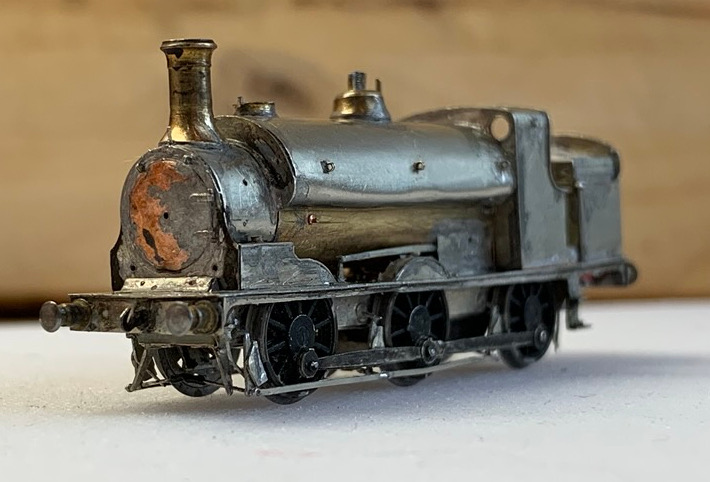
Jim's Jubilee pug now has wheels and ran smoothly on the layout. A nice-looking engine which justifies the blood, sweat and tears related in his RMWeb chronicle. The driver seems to have burned the smokebox and will no doubt have his pay docked as a result. Will it have paint and couplings in time for Model Rail Scotland?
Simon continues to make progress on his Glenfinnan project, advancing with turnout construction and painting his Foxhunter LNER fish van bodies first with grey primer then with matt bauxite.
And that was it. Thanks to Simon once more for copious amounts of bacon rolls, tea, coffee and panettone (a bit fancy, but that's Shawlands for you). A few more working sessions are planned at Simon's, panettone or not, before Sauchenford's swan song at Model Rail Scotland on 21-23 February.
Saturday, 9 November 2019
November 2019 meeting
Andy, Alistair, Alisdair, Gordon, Jim, Stephen and Graham met at Simon's house for another session aimed at adjusting the fiddle yard cassettes for Sauchenford. The first job was to fit adjusters to the support structure legs. The adjusters come with pronged T-nuts.
Screw in the feet, turn the supports the right way up again, and job done. We now had a non-rocking layout support. It was time for soup and bacon rolls, and a long discussion on whether we want to do another group layout and why. The consensus was that a pair of (non-cassette!) fiddle yards should be built to go on one or both ends of a 3' to 4' scenic section with well-lit sidings at the public side, controllable from front or back. The idea is to create a series of such scenic units mainly as learning exercises for skills development, rather than aiming at exhibition-standard finished layouts, and to dispose of them without fuss once they have served their purpose. The fiddle yards will be re-used.
This meeting was also intended to have a "show and tell" session and there were a few things to look at. Alisdair had progressed some buildings: a Highland Railway goods shed (the smaller standard design) based on Lairg. I recall the shed at Forsinard was very similar. It's built with a base designed to locate in to a socket in the layout scenery. The roof is from Evergreen styrene corrugated iron.
Also a platelayer's sleeper-built hut:
Grandtully station appeared in a blog entry a few months back, but it has now been painted:
Complementing it is a standard Highland Railway signalbox, completed some time ago:
Jim had his Jubilee Tank with him to let us see the latest state of play: brake gear has been added. The 3D-printed wheels are expected to be delivered from a small but well-connected firm of wheelwrights in Kelso before Christmas, with luck. It’s a turning into a bit of a Cliffe-hanger.
Finally, Sauchenford had an unusual visitor in the shape of Simon's Californian Zephyr which he recently put together from a kit.
Many thanks to Simon for once again hosting the meeting. The December session is planned to be in Edinburgh.
Drill the legs ...
Place a T-nut in each hole ...
Tap in firmly ... if you are of a nervous disposition or if the leg is slender or its material anything other than ironwood, you may wish to tap in cautiously, or to apply G-cramps to the sides to protect the leg from splitting if the fit is tight. Of course, as experienced modellers, this did not happen to us, because we would have foreseen the possibility and taken exactly these precautions. And if it did happen, it is very hard to see.Screw in the feet, turn the supports the right way up again, and job done. We now had a non-rocking layout support. It was time for soup and bacon rolls, and a long discussion on whether we want to do another group layout and why. The consensus was that a pair of (non-cassette!) fiddle yards should be built to go on one or both ends of a 3' to 4' scenic section with well-lit sidings at the public side, controllable from front or back. The idea is to create a series of such scenic units mainly as learning exercises for skills development, rather than aiming at exhibition-standard finished layouts, and to dispose of them without fuss once they have served their purpose. The fiddle yards will be re-used.
This meeting was also intended to have a "show and tell" session and there were a few things to look at. Alisdair had progressed some buildings: a Highland Railway goods shed (the smaller standard design) based on Lairg. I recall the shed at Forsinard was very similar. It's built with a base designed to locate in to a socket in the layout scenery. The roof is from Evergreen styrene corrugated iron.
Also a platelayer's sleeper-built hut:
Grandtully station appeared in a blog entry a few months back, but it has now been painted:
Complementing it is a standard Highland Railway signalbox, completed some time ago:
Jim had his Jubilee Tank with him to let us see the latest state of play: brake gear has been added. The 3D-printed wheels are expected to be delivered from a small but well-connected firm of wheelwrights in Kelso before Christmas, with luck. It’s a turning into a bit of a Cliffe-hanger.
Finally, Sauchenford had an unusual visitor in the shape of Simon's Californian Zephyr which he recently put together from a kit.
Sunday, 20 October 2019
October 2019 meeting
There was a good turn-out of FCAG members for this month's meeting: Andy, Jim, Stephen, Alistair, Alisdair, Nigel and Chris met at Graham's house in Edinburgh. The objective was to continue testing Sauchenford's fiddle-yard cassettes in an attempt to get derailment-free entry and exit, something which has so far eluded us.
The layout support is intended to be assembled by two people in a few minutes. Instead, we tried to assemble it with six people, as a result of which it took more like half an hour to erect.
Things went better with fewer hands.
Once erected it was found not to be level. Alisdair took charge, since he is now a one-day-a-week PW surfaceman on the local Bo'ness and Kinneil preserved railway ... plus, he is bigger than most of the rest of us. A spirit level was deployed, inconclusively. Attempts were made to blame the floor.
Finally he demanded a length of string and showed us how to detect a humpy-backed board using three rods of identical diameter.
The conclusion was that it did not matter too much if the base was level, since it would be necessary to pack up the layout boards anyway.
The Short Talk this month was from Nigel, who told us about his recent experiments towards producing an simple, low-cost sound system for the "Burntisland" P4 layout of the Scalefour East of Scotland group.
The idea is to use a Raspberry Pi (or Arduino or similar single-board computer) to play a range of sound clips. The requirement for Burntisland is to create the ambient noise of a nineteenth-century ferry port with train occasionally passing through the scene. The script Nigel has written for the Pi can play eight sound clips simultaneously from an arbitrarily-large selection. First of all a 20-minute-long seaside sound background is played in a loop (the length avoids any impression of repeated sounds). Seagull noises are also played in a loop, but faded up and down to simulate approaching and retreating birds. Other noises can be triggered by push buttons (for example, the ferry's siren, or rattling chains for the linkspan) or by reed-switch or optical sensors. On Burntisland, the sequence of trains leaving the fiddle yard is known, so the software allows appropriate sound clips to be ready in the correct sequence and then started as the train enters the viewing part of the layout.
The point of the system is its minimal cost (just £30 for the Pi, with a mobile phone as a command console or a £50 touchscreen for the luxury version, plus wire, push-buttons and speakers; and further cost reduction may be possible once development is complete using an embedded-application device like the PiZero, at one-tenth the cost). It avoids the cost, complexity and difficulty of retrofitting DCC sound to scratch-built models and handles train and non-railway sounds equally well. It allows soft menu selection from the touchscreen when this is advantageous (cueing up a series of trains from a list) but permits fast selection by physical button when timing is critical (synchronising sound with on-scene actions). All in all a most interesting idea which adds further realism to finescale models.
As we consumed soup and bacon rolls, Jim showed us the current state of his Jubilee Pug project:
Further details are on RMWeb. The stainless-steel 3D printed wheels are still under development but the machining operations required to finish them have more or less been agreed.
Chris has made progress with his 4F chassis and had also brought along his first 2mm point for us to admire.
The rest of the meeting was spent adjusting fiddle-yard cassettes. Several were passed for for service and several others were condemned and will be reduced to their component parts for possible reuse. The cassette system on Sauchenford seems to have caused problems well out of proportion to its complexity. What we have learned is that careful storage is necessary to avoid damage to fiddle yard track and cassettes alike, and that none of the three or more designs we have tried to connect power reliably to the cassette is satisfactory. Aluminium angle is a nice material for structural use but not so good for reliable pickup. On the other hand, a cassette system combined with a swear-box would be an excellent way of financing a layout.
Next month's meeting will, we hope, be in Glasgow, and will continue the theme of testing and fettling.
The layout support is intended to be assembled by two people in a few minutes. Instead, we tried to assemble it with six people, as a result of which it took more like half an hour to erect.
Things went better with fewer hands.
Once erected it was found not to be level. Alisdair took charge, since he is now a one-day-a-week PW surfaceman on the local Bo'ness and Kinneil preserved railway ... plus, he is bigger than most of the rest of us. A spirit level was deployed, inconclusively. Attempts were made to blame the floor.
Finally he demanded a length of string and showed us how to detect a humpy-backed board using three rods of identical diameter.
The conclusion was that it did not matter too much if the base was level, since it would be necessary to pack up the layout boards anyway.
The Short Talk this month was from Nigel, who told us about his recent experiments towards producing an simple, low-cost sound system for the "Burntisland" P4 layout of the Scalefour East of Scotland group.
The idea is to use a Raspberry Pi (or Arduino or similar single-board computer) to play a range of sound clips. The requirement for Burntisland is to create the ambient noise of a nineteenth-century ferry port with train occasionally passing through the scene. The script Nigel has written for the Pi can play eight sound clips simultaneously from an arbitrarily-large selection. First of all a 20-minute-long seaside sound background is played in a loop (the length avoids any impression of repeated sounds). Seagull noises are also played in a loop, but faded up and down to simulate approaching and retreating birds. Other noises can be triggered by push buttons (for example, the ferry's siren, or rattling chains for the linkspan) or by reed-switch or optical sensors. On Burntisland, the sequence of trains leaving the fiddle yard is known, so the software allows appropriate sound clips to be ready in the correct sequence and then started as the train enters the viewing part of the layout.
As we consumed soup and bacon rolls, Jim showed us the current state of his Jubilee Pug project:
Further details are on RMWeb. The stainless-steel 3D printed wheels are still under development but the machining operations required to finish them have more or less been agreed.
Chris has made progress with his 4F chassis and had also brought along his first 2mm point for us to admire.
The rest of the meeting was spent adjusting fiddle-yard cassettes. Several were passed for for service and several others were condemned and will be reduced to their component parts for possible reuse. The cassette system on Sauchenford seems to have caused problems well out of proportion to its complexity. What we have learned is that careful storage is necessary to avoid damage to fiddle yard track and cassettes alike, and that none of the three or more designs we have tried to connect power reliably to the cassette is satisfactory. Aluminium angle is a nice material for structural use but not so good for reliable pickup. On the other hand, a cassette system combined with a swear-box would be an excellent way of financing a layout.
Next month's meeting will, we hope, be in Glasgow, and will continue the theme of testing and fettling.
Sunday, 22 September 2019
September 2019 meeting
On a lovely sunny day, Alisdair, Simon, Graham, Andy and Alistair met at Jim's house in Biggar for a session aimed at getting Sauchenford ready for its next and possibly last outing (Model Rail Scotland in February).
The layout and its support structure are stored on the west and east coasts of Scotland respectively, and the legs had been altered since last time we erected the layout, so this was a chance to check that the support was adequate and could be quickly erected.
The support is in two parts and is based on Dexion angle rescued by Andy from a skip, with wooden legs which fold more or less flush for transit. In fact there are two sets of legs, a shorter set for working on the layout and a longer set for shows. Today the shorter set was in place. Bolts with wing nuts are used to hold everything up. First the legs were swung out and secured on the two sections:
Next they were bolted together (the Dexion makes it easy to shorten or lengthen the platform as required):
With the support ready, the fiddle yards were brought out - they are now stored for transit with their modesty boards bolted in place - and the two parts separated:
and finally the scenic section was placed between them:
So far so good, and we moved on to discuss progress with personal projects.
Jim, as usual, has not been idle in the past month, and had a couple of interesting new etches for us to look at. One is a track cleaner etch imitating his hand-filed version, developed as a result of a discussion on RMWeb:
The tool is designed to burnish the track rather than abrade it, so it does not really wear much in use, nor is the track damaged. On the other hand, it is very good at removing gobs of glue or ballast which has stuck to the rail side ... and it can be used through crossings without removing the paint from check and wing rail surfaces. A handy little thing.
Another novelty was a new version of his signal wire pulley stakes, this time designed so that mere mortals might have a chance of assembling it. The etch is designed as two halves which fold over into alignment, to be sweated together.
Simon has been progressing with his LNER 10T fish van fleet, from Foxhunter body kits, and had brought the proof to show us.
He had made a nifty tool to thin the van roofs to something nearer to scale: a piece of wooden dowel of roughly the right diameter with wet-and-dry paper secured to it, to make a large round sanding stick:
All this description of modelling activity was quite stressful for the Edinburgh contingent, so we stopped for a spot of lunch in the sunshine.
Once we had polished off the ham sandwiches and hot soup (in spite of the sun and 20-degree heat, pullovers and jackets were sported: warm days are treated with suspicion north of the Border), we were joined by Mick Simpson, who had wangled an afternoon off from grandparenting, and we went back indoors for the Short Talk. This time we were to hear about scenic techniques for grass, trees and bushes, from Jim who is in the process of working up the scenery on Kirkallanmuir (which, as a reminder, is his home layout based on a Clydesdale mining village set in Caledonian days).
Jim has formed the scenic areas of the layout from a shell of expanded polystyrene profile blocks at intervals, covered with strips of newspaper and a mush of chopped-up cardboard egg-boxes, covered with a base layer of green paint. Grass is added using the often-described static applicator technique - it was nonetheless instructive to see it demonstrated.
The area to be grassed is masked off with pages from the Lanark Gazette:
The applicator was bought commercially but looks suspiciously like a combination of an electric fly-swatter and a metal kitchen sieve. Jim didn't mention specifically where he'd obtained his, but a similar-looking one is available on eBay at a price which makes it hardly worth the trouble of building your own. The earth wire is secured to a nearby part of the layout with a drawing pin, and the sieve is filled with a small amount of 2mm grass fibres.
Next, a quick squirt of cheap sticky hairspray is applied to the masked area:
and the sieve is gently shaken to distribute the fibres. It takes a minute or two to shake even a small amount of fibres onto the layout, and they need to be applied quite densely.
The dead heads of these can be harvested in winter and dried:
then the flowers can be detached, leaving thin twigs which form the basis for model trees. On their own, the heads may be a little sparse, so extra "branches" can be inserted by carefully slitting a twig with a scalpel and opening out slightly with a small screwdriver before splicing in another twig, fixing it with white PVA. If the lower trunk is not thick enough, fine wire can be added to bulk it out.
The bare structure can now be planted on the layout in holes made by a screwdriver or piece of stiff wire. It's better to plan ahead to build woodland areas entirely from expanded-polystyrene blocks since this holds the tree in place much better than a thin skin scenic skin.
The base of the tree is given a light coat of dried tea-leaves harvested from a used teabag:
Next, PVA is dabbed onto the branches, then little tufts of foliage (Jim uses Woodland Scenics foliage net in Light Green and Dark Green shades) are added one by one to give a convincing cover.
Bushes can be created using little pieces of lichen harvested from trees (Jim picked his up when visiting the wets coast of Scotland). These are sprayed with hairspray, dipped in old-fashioned scenic flock powder, then added to the layout.
The end result is pretty convincing and, once completed across the whole layout, should make Kirkallanmuir a poster-child for climate change activism. Oh, wait, it's a colliery layout. Never mind ...
Quite a long day but we got through a lot. Another testing session will take place at next month's meeting, which will be in Edinburgh. Thanks from all of us to Jim for his hospitality and scenic musings.
The layout and its support structure are stored on the west and east coasts of Scotland respectively, and the legs had been altered since last time we erected the layout, so this was a chance to check that the support was adequate and could be quickly erected.
The support is in two parts and is based on Dexion angle rescued by Andy from a skip, with wooden legs which fold more or less flush for transit. In fact there are two sets of legs, a shorter set for working on the layout and a longer set for shows. Today the shorter set was in place. Bolts with wing nuts are used to hold everything up. First the legs were swung out and secured on the two sections:
Next they were bolted together (the Dexion makes it easy to shorten or lengthen the platform as required):
With the support ready, the fiddle yards were brought out - they are now stored for transit with their modesty boards bolted in place - and the two parts separated:
and finally the scenic section was placed between them:
So far so good, and we moved on to discuss progress with personal projects.
Jim, as usual, has not been idle in the past month, and had a couple of interesting new etches for us to look at. One is a track cleaner etch imitating his hand-filed version, developed as a result of a discussion on RMWeb:
The tool is designed to burnish the track rather than abrade it, so it does not really wear much in use, nor is the track damaged. On the other hand, it is very good at removing gobs of glue or ballast which has stuck to the rail side ... and it can be used through crossings without removing the paint from check and wing rail surfaces. A handy little thing.
Another novelty was a new version of his signal wire pulley stakes, this time designed so that mere mortals might have a chance of assembling it. The etch is designed as two halves which fold over into alignment, to be sweated together.
Simon has been progressing with his LNER 10T fish van fleet, from Foxhunter body kits, and had brought the proof to show us.
He had made a nifty tool to thin the van roofs to something nearer to scale: a piece of wooden dowel of roughly the right diameter with wet-and-dry paper secured to it, to make a large round sanding stick:
All this description of modelling activity was quite stressful for the Edinburgh contingent, so we stopped for a spot of lunch in the sunshine.
Once we had polished off the ham sandwiches and hot soup (in spite of the sun and 20-degree heat, pullovers and jackets were sported: warm days are treated with suspicion north of the Border), we were joined by Mick Simpson, who had wangled an afternoon off from grandparenting, and we went back indoors for the Short Talk. This time we were to hear about scenic techniques for grass, trees and bushes, from Jim who is in the process of working up the scenery on Kirkallanmuir (which, as a reminder, is his home layout based on a Clydesdale mining village set in Caledonian days).
Jim has formed the scenic areas of the layout from a shell of expanded polystyrene profile blocks at intervals, covered with strips of newspaper and a mush of chopped-up cardboard egg-boxes, covered with a base layer of green paint. Grass is added using the often-described static applicator technique - it was nonetheless instructive to see it demonstrated.
The area to be grassed is masked off with pages from the Lanark Gazette:
Next, a quick squirt of cheap sticky hairspray is applied to the masked area:
and the sieve is gently shaken to distribute the fibres. It takes a minute or two to shake even a small amount of fibres onto the layout, and they need to be applied quite densely.
Jim follows the initial 2mm fibre application with 1mm fibres, and also varies the colours, finishing with "patchy dead grass". An internet search (or a browse of the scenic stalls at shows) will reveal plenty of suppliers and colour choices.
Next Jim moved on to discuss trees. In his garden can be found a few Sedum plants, commonly known as stonecrop.
then the flowers can be detached, leaving thin twigs which form the basis for model trees. On their own, the heads may be a little sparse, so extra "branches" can be inserted by carefully slitting a twig with a scalpel and opening out slightly with a small screwdriver before splicing in another twig, fixing it with white PVA. If the lower trunk is not thick enough, fine wire can be added to bulk it out.
The bare structure can now be planted on the layout in holes made by a screwdriver or piece of stiff wire. It's better to plan ahead to build woodland areas entirely from expanded-polystyrene blocks since this holds the tree in place much better than a thin skin scenic skin.
The base of the tree is given a light coat of dried tea-leaves harvested from a used teabag:
Next, PVA is dabbed onto the branches, then little tufts of foliage (Jim uses Woodland Scenics foliage net in Light Green and Dark Green shades) are added one by one to give a convincing cover.
Bushes can be created using little pieces of lichen harvested from trees (Jim picked his up when visiting the wets coast of Scotland). These are sprayed with hairspray, dipped in old-fashioned scenic flock powder, then added to the layout.
The end result is pretty convincing and, once completed across the whole layout, should make Kirkallanmuir a poster-child for climate change activism. Oh, wait, it's a colliery layout. Never mind ...
After that scenic tour-de-force we returned to Sauchenford, cleaning the track and testing stock.
We started with out-of-the-box conversions of Dapol Type 2 diesels before moving to shorter-wheelbase locos:
Subscribe to:
Posts (Atom)