Wednesday, 12 April 2023

April 2023 Forth and Clyde Area Group Meeting

Throughout Central Scotland, the sound of scurrying feet could be heard last Saturday. "What could be causing such a commotion?" was the cry from the worried populace. Was the End of The World nigh? Truly scary times, what with the sky having mysteriously darkened the previous afternoon. However, thankfully, in due course the said populace was able to heave sighs of relief. (Point to ponder - why are sighs of relief always so heavy as to require heaving, as opposed to gently lifting?) 

Of course, those cognoscenti wot read this blog, will already have been aware that it was the second Saturday of the month, when the scurrying feet are sure to be those of the keen members of Forth and Clyde Area Group of the Two Millimetre Scale Association making their way to their monthly conventicle at Almondell.

This month, the numbers were slightly down, due, no doubt to the fashion of taking holidays around Easter time. For those errant members, such backsliding will result in a period using the Blunt Scalpel of Repentance at the next meeting. Yese have been warned! However, the Faithful were represented by only 2 Als, but two J's along with solitary examples of a Simon, a Nigel, an Andy and, back for a second time, Stuart, groping towards the light.

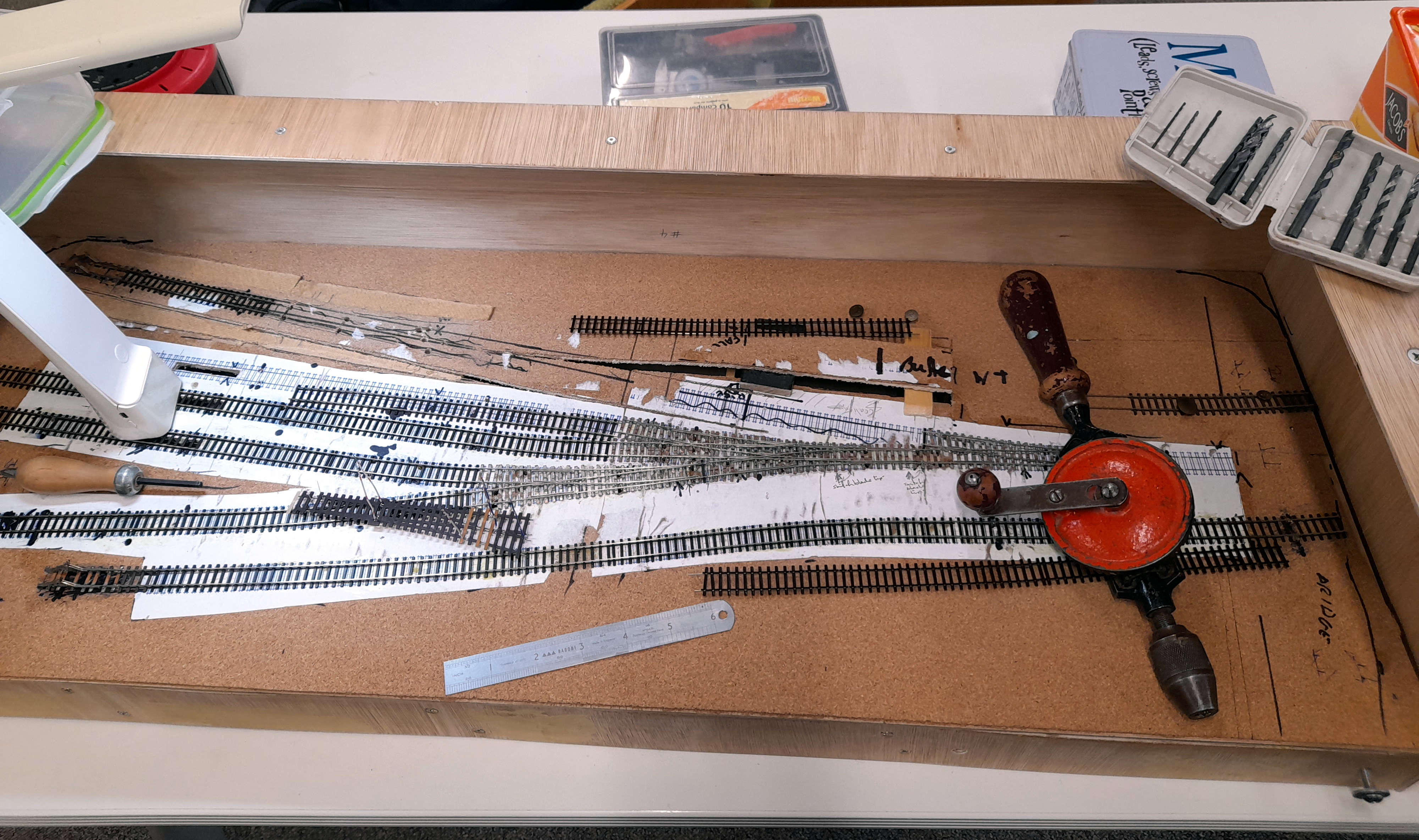
More home sledgehammer work had been undertaken over the preceding month, with nearly all the track on the Group demo layout laid:

Nigel and Jim duly got to work on making switches on the turnouts operational, by linking up the already installed Turnout Operation Units (Association 3D printed, for youse nosey wans) with double throw single pole switches by rod in tube. 
Successful, except for the one at the entrance to the coaling stage (the nearest on in the photo above), with the run proving too long and convoluted to allow satisfactory working. Thoughts will be garnered as to how to sort this out - probably involving a stretch of rod with crank. Once that is done, we can run stock over the track using the Hand of God, as leccy has yet to be introduced, to start checking the trackwork. The next stage will be wiring, after which we can get on with the full track check.
 
There was some discussion over the best way of attaching the backscene, which will have to be removable to allow the layout to be packed away. Not yet sorted out, but some ideas were starting to formulate. Inspired by this discussion, Al the Artist was sketching away at some possibilities for the backscene:

Meanwhile, Simon had brought along an American N Gauge train (whit!) to run on the ESME layout. It chuntered its way round very effectively nearly getting some words of admiration. At least the gauge is correct for scale, with it being American N. But, still, that sort of apostasy needs to be stamped out, before it gets hold of his soul...
However, he is not totally lost to perdition, as he had brought along (yet more) fish vans being built to the One True Scale which he was bringing to fruition:
New chap, Stuart, was progressing his mill building, which he had brought along last week. He was applying acrylic paint to it to simulate the millstone grit with which the prototype was constructed. It was coming up a treat with some subtle variations bringing it to life. Unfortunately, the subtlety doesn't show in the photo below:

 Andy, who is in the throes of converting his extant N gauge layout to 2FS, had brought along some lengths of Easitrak into which he was threading rails, using his Great Rail Threading Machine (patent pending) :

Lastly, although I have been trying not to reveal the shame of it, one of our members just sat at his table and got steaming with a piece on electric chips. (Ahhh! Piece on chips! Magic!)

Fear not though, gentle reader, for it was not the sort of steaming which is all too common in the West on a Saturday, but the creation of water vapour by magic, by means of a sort of electronic gizmo, apparently called a piezo-electric chip (must get my hearing checked), creating steam and the subsequent water vapour, from water drawn up via an absorbent cylinder in the bottle below:

Why this madness? Well, James is a two-timer who is also involved in the 4mm East of Scotland mob's magnum opus, Burntisland. Apparently, he is hoping to use it to bring some atmosphere to the loco roundhouse. Your scribe is amazed at the things some can do with volts.

Anyway, that's it until next month, when we will meet on the 13th May. That's only one week before the World Famous Scottish 2mm Association Mini-meet also being held at Almondell. An event not to be missed. Be there or be a equal sided rectangle.


Saturday, 11 March 2023

March 2023 Forth and Clyde Area Group meeting

Maybe the threatened bad weather had something to do with the reduced turnout. Andy, Alistair, Alisdair, Graham, Chris, new member Stuart, and curious visitor Jack met at the usual Almondell venue for a show-and-tell session. The ESME clubroom was snug and warm in spite of the hard frost outside.

The group diorama is making progress: most of the track is down and the final turnout - on the coaling bench siding - was to be laid today.


Chris has been working on his Raithby 4F. The boiler is now attached to the frames.


Andy has been prepping his old N gauge layout for the forthcoming Further North open day. The N gauge has been torn up, Easitrack has been laid, and ballasting commenced. He was working on turnouts.


Stuart, who joined the Association at the Glasgow show last weekend, showed us his first attempt at a model building, and very impressive it was too - a mill from the Calder Valley ... no, not the one in South Lanarkshire, the Calder Valley in England deep in L&Y territory.

The exterior walls overlays are from 1.5mm mounting board, with stomework scored on with a knife.


The overlays are then used as templates to locate the window openings on a shell of 1mm clear acrylic sheet covered with a white film which is cut away slightly smaller than the template (by drawing with a point slightly offset from the overlay cutout) to represent windows with reveals.


Glazing bars are then drawn on by ruling pen in dilute acrylic paint. The walls are joined with pipe welding cement from Screwfix. The base has an extra couple of centimetres depth so it can be sunk into the surrounding scenery. Pretty impressive for a first structure model!

Graham talked about 3D roof design and printing for Jim Watt's impressive Caledonian Railway 12-wheeler Edinburgh-Glasgow coaches.

Alisdair explained how he built a stone bridge destined for Laurie Adams' Yeovil Pen Mill layout. The dressed ashlar slabs are represented be SE Finecast styrene sheet, chopped up and laid in strips to overcome its rather obvious step-repeat pattern. The voussoirs (Alisdair speaks French to impress us when Scotstoun is out of earshot, but apparently these are the stones in the arch outside face) are in raised relief formed by applying drops of life-expired thick Easitrac glue with a cocktail stick to the centre of each hand-carved stone. Three or four coats are used with ten minutes between each - just time to have another cocktail.


It has to be said it's a nice model. How will we keep Alisdair focused on the Highland now he has discovered the Great Western?

That's it for this month, thanks for reading.

Wednesday, 8 February 2023

February 2023 Forth and Clyde Area Group Meeting

Meeting, unusually, on the first Saturday of February, the brave stalwarts of the Forth and Clyde Area Group met at our usual haunt of at the Headquarters of the Edinburgh Society of Model Engineers at Almondale near Livingston. The Press Officer was unable to make an appearance due to other commitments and so a game of “not me” was played to find who would pen the piece on this meeting.

After several long minutes of silence and examination of the floor as we studiously avoided eye contact, it came to light that I, this months humble reporter, would be missing next month’s meeting as I’m travelling to the far and distant land of Bury, to ride behind Flying Scotsman as she runs on the East Lancashire Railway. The general consensus of the room that this is a dirty LNER locomotive, vastly inferior to the great mechanical marvels of Sir William Stanier, and as penance I would have to take on the mantle of the blog for this month*.


In attendance this month were Alisdair, Alastair, Alistair, Jim, James, Simon and I, your willing volunteer, Martin. There was a great deal of modelling ongoing, with the Group Layout, an engine shed for taking to exhibitions, with personal projects studiously being worked on and on show:


After lunch, James led a talk on layout wiring.

He showed a method of keeping it simple that has worked for him on his own layout and several group layouts he has worked on. The overall premise was to plan in the first instance with just plain line – he reiterated the advice given in the "Track" book of two droppers of each polarity per section of track.

James showed, using the diagram enclosed with an Easitrac B6 turnout (now out of production) his view on how to wire these, with isolation gaps and bonding rails together. There was some discussion on the position of these gaps in Easitrac vs. other building options (the milled common crossing on Easitrac provides convenient gapping at the V whereas other methods require a little more thought).

His advice was that DC and DCC can be wired in roughly the same way – with the addition of isolation switches if required, in the DC world.

Keeping it simple and keeping notes was vital to help with fault finding – you might remember it at the time, but in the future? “If you write it down, you’ll never need to refer to it again” he commented with the inverse unsaid but alarmingly true!

He was a fierce opponent of chocolate block connectors as they can mangle wire that is put in and out repeatedly, however did acquiesce later that the use of bootlace ferrules (a set with a crimper is ~£18 on eBay) neatens this up. Others did discuss alternatives, including soldering the ends of wires before using choc-blocs but James outwardly cringed at this too… He also said he wasn’t a huge fan of the D-type connectors, as some of the manufacturing methods can leave these vulnerable to damage when attaching your own wires.

James had provided a scan of the Squires catalogue and the switches listed there, then over the next several slides, demystified the differences. The details of single and double pole, single and double throw and the various applications for these on a model railway was covered with schematic diagrams which showed potential applications.

All-in-all, from my point of view, a good introduction to layout wiring – for followers of my progress, I’m not quire at this stage of the building process, but it’s on the near horizon. I’ve often struggled here and unnecessarily overcomplicated things, but this provides a useful grounding.

We returned to individual projects after the talk.

Simon was working on the Group Layout – he was soldering droppers and laying turnouts. He had brought along a section of his Glenfinnan station throat, and dry fitted a couple of servos to the turnout operating units.


Jim had brought along his Caledonian Railways 65’ First and Brake Thirds – now complete with lettering and CR crests, but awaiting roofs – these are being 3D printed and are on their second or third iteration due to an issue with the CAD. I’ve been following Jim’s build on RMWeb (https://www.rmweb.co.uk/topic/174408-cr-65ft-first-and-matching-brake-3rds/page/2/#comment-5072588) as I have a passing interest in the Caley, but seeing the detail he’s achieved in real life was incredible(!).

Jim was also working on the buffer stops for the Group layout. After someone (who might have been me…) bought the last of the CR Heavy stops from Shop 1 – Jim decided to build his own from scratch using rail and some home made jigs. Again, sorry Jim…


The jigs, as described on RMWeb (https://www.rmweb.co.uk/topic/65499-whats-on-your-2mm-work-bench/page/164/#comment-5079816) are made from layers of card. The results are shown in the picture alongside.


Jim and Simon spent some time marking the positions of the buffer stops to the layout – so that Simon doesn’t lay extra track which then needs taken back up.

Alisdair, after some prodding, confessed to working on a GWR prototype, of Pen Mill bridge for Laurie Adam’s Yeovil layout. There were lots of bits of plasticard on the bench, with very precise incisions in them which must mean something to Alisdair, if no-one else! The confession that he was working on a GWR prototype elicited a ne’er before heard confession from Jim, that he had a test etch of an NBR wagon(!) for Miles, who wasn’t present.

Alisdair had also brought along his Push/Pull set to go with his ex-NBR class M (LNER C15) "Yorkie" tank. These are modified Worsley Works etches of Gresley non-corridor stock. He also spent sometime with a large tape measure taking measurements in a wee book that he assures us is for the Scottish Mini Meet advertised in the most recent 2FS Newsletter

NBR, LNER and GWR – and I was getting stick for visiting Flying Scotsman! Must be Chairman's privilege!

On the subject of the NBR/LNER, Alastair was working on CAD for a N14/15 tank. His intention, with access to machine tools, is to produce a milled chassis for weight and marry this to a self-produced 3D Printed body. As previously reported, Alistair has been working on 3D printing some NBR mineral wagons for his intended layout of South Queensferry – he reported progress on these, now printing the W-irons and base as a single piece and the sides as single pieces and gluing it all together, however, he brought none along so we have to settle for an action shot…

Staying with the Al’s, Alistair was working on his plan for a layout. He has a beautiful pencil drawn plan heavily inspired by Leith Citadel with a single platform, a run around loop and goods yard. His plan (which I neglected to get a photo of, but caught the great ma whilst imbibing sustenance and reading a S4 Society Journal (eh?)) shows what looks like a double track access to the station, but is, instead, a single track access with an outgoing industrial branch so that wagons can be shunted in the station then drawn back and into the sprawling industry of the city (modelled off-scene).

He is planning a traverser with access to under-scenery storage roads, and found James’ talk on layout wiring most useful!

 Which segues nicely (almost like I planned it) to James. He had brought along DG couplings but by his own admission, hadn’t made much progress – although he and I did have a good chat about how to make and fit these necessary, but fiddly components. Again, I forgot to get photographs, but James had produced a jig, that doubled as a practise cassette for his shunting plank.

James is converting old Peco/Farish/Dapol freight stock to 2FS and fitting DGs for the shunting plank and found these all have different coupling heights – not so much of an issue with the big hooks of N Gauge, but problematic for 2FS – his jig allows him to sit a wagon in place then use some feeler gauges to determine the amount of packing that would be required for a level fitting.


Which leaves me. I took a couple of projects along and didn’t achieve much – except recharge my enthusiasm. For those who follow my own ramblings on RMWeb (https://www.rmweb.co.uk/topic/175339-martins-2mm-musings-and-maybe-a-layout/) – excuse the shameless plug – you may have seen I found my enthusiasm waning of late, I’d hit a couple of snags, put things down and just never quite got back to them.

In the course of speaking with everyone and taking notes to put this blog together, I found solutions to a lot of the issues I was having, with offers of ideas and help. So when I got home I got the tools out and started making some more progress, putting the muffs into the frames for my ex-CR439 Class, soldering in the frame spacers and gapping the frame. Simpson springs required next, and a motor/gearing. And I need to work on the trailing bogie after mangling my first attempt. Still a long way to go, but from tiny acorns etc.


There will be a chance to meet the motley Forth and Clyde crew at Glasgow Model Rail Exhibition on Friday 24th to Sunday 26th February when we will be manning the 2mm Scale Association Road Show.. Come and speak to us. We rarely, if ever, bite.

I’ll have to look forwards to April for my next meeting, however, for anyone else who wishes to attend, FCAG will meet again on Saturday March 11th at the Usual location. Work is set to continue on the Group Layout although no talk is currently scheduled, so bring a personal project!


*I actually did volunteer…


Saturday, 7 January 2023

January 2023 Forth and Clyde Area Group meeting

A showery, bright day for our first meeting of the year, at ESME's Almondell headquarters as usual.


Alisdair, Alastair, Alistair, Chris, Graham, Nigel, Andy, Miles, Simon and Martin attended. The demo layout was unboxed ...


and Alisdair made some high-precision holes for dropper wires, with the obligatory pair of observers to make sure he did not catch his fingers in the drill.

Alastair was making progress on his 3D North British wagon, fortified by a well-known (in Scotland at least) orange liquid - antifreeze perhaps, given the bracing temperature in the meeting room. Disappointed with distortions when printing the wagon as a single unit, Alastair has now opted to sprue the side and ends up and print vertically.


 Alistair was planning and sketching.

Andy continued to work on Finetrax points, which have caught the attention of several FCAG members.

Chris was working on his 4F. His next task is to install stay-alive capacitors, and he was deciding how these would be disposed along with the DCC chip in the available space.


Over Christmas he resurrected the cab interior fittings he had worked on earlier in the year, and finished them off. They're quite small.


Simon had a piece of Glenfinnan with him and was working on installing turnouts. Again, a can of the mystical orange liquid is within easy reach, bestowing a warmth which necessitates shortening of sleeves..


A clothes peg is a handy way to hold a dropper wire steady for soldering. I wish I'd thought of that when I did the same job recently ...

Association turnout operating units are much in evidence.

Martin was working on pointwork as well.

Over Christmas he worked on his J94 and produced a train of seven vehicles for it to haul. Where does he find the time ...

Miles had several interesting tools worthy of note. The bench hook at top left doubles as a sloping work surface. The cork bung (eBay) at top right and cork sanding block (bottom left) allow work to be brought up to a convenient height for working, jeweller-style, helpful if wrist action is restricted. The fine-grit filing sticks, bottom right, are from lolly sticks with 3M microfinishing film. The black anti-slip matting has one surface for work ...

 ... and the reverse side is ridged, handy to stop round items from rolling away. Miles sleeves his paintbrush handles to make them a consistent size for easy manipulation.


Graham had printed a Caledonian 65' 3rd class saloon roof from Jim Watt's CAD file ... the print is not perfect but a few more supports should sort out the sags on one edge. A work in progress.

Nigel was starting out on a wagon etch. He and Miles …puir Southrons baith … had nae mystical orange liquid. Instead, ever practical, Nigel had packed a small but efficient electric fire in his Mini, and deployed this between himself and Miles to take the edge off the afternoon chill.


There was some discussion of the market potential for 2mmSA branded electric bodywarmers, or for traditionalists, perhaps finescale fingerless mittens and hot water bottles. Please address messages of support to the Chairman.

We will move back to the second Saturday for next month's meeting. The group will also be manning the 2mmSA roadshow at the Glasgow show from 24-26 February. Orange liquid is available there from vending machines. If you are visiting the show, please be sure to stop by for a chat.


Sunday, 11 December 2022

December 2022 Forth and Clyde Area Group meeting

There were a few centimetres of snow on the ground at ESME's Almondell premises for our December meeting. Steven, Alisdair, Alastair, Alasdair, Martin, Andy, James and Graham attended. The main aim of the meeting was to make some concrete progress with our engine-shed micro-layout. There is to be a coaling bench with a raised track, and much discussion was devoted to how the vertical curves of the approach section of this track could be kept sufficiently gradual to ensure good wheel contact.

Most attendees were in their winter plumage of multiple fleece layers. ESME's heat pump works well, we are told, if the pump is running well before the room is used ... less so if that is not done ...  however, at least this winter we don't have to keep the windows open for health reasons. Alisdair and Andy kept themselves warm by arguing about whether the cork surface should be disturbed. The rest of us huddled over our soldering irons.


Andy then attacked the baseboard with a saw and freed a strip of ply, complete with cork, so it could be prised up at one end, forming a natural transition curve in the vertical plane. After that we started to solder dropper wires onto turnouts: two wires to each rail section, in an attempt to improve reliability.

Martin is proceeding quickly with his own project, a BLT based loosely on the track layout at Barnton, in the Edinburgh suburbs. He is much enamoured of the latest design of Finetrax turnouts, having built six in a weekend.: he reckons he can now take one out of its packet and have it completed in a mere 25 minutes. The turnout on the right with interlaced sleepers was produced after studying Jim Watt's Kirkallanmuir series of articles in the 22SA magazine.

Alasdair recently added an Elegoo SLA 3D printer to his existing filament printer, and has used it to print a North British open wagon with integral W-irons from his own design. He is pondering how to deal with bearings for pinpoint axles.


.He was also wielding an interesting and very precise gripping implement with a natty soft-pressure squeeze-to-lock, squeeze-to-unlock action. This turned out to be a microsurgery needle holder. Alasdair's is a German-made model by S&T . The business end is to the left. eBay seems to offer similar implements with a range of manufacturers and qualities.


Another of his handy tips is to use a strip of closed-cell foam to hold a variety of drills in size order, glued under the lid of a plastic tub which lives in his toolbox. Larger drills sometimes fall out but the smaller ones stay put. Very convenient.


That's all for this month. Next time we will exceptionally meet on the first Saturday of  the month, on 7th January. Thanks for reading this far, and have a happy Christmas and New Year!